The Odyssey (2026) Review
Christopher Nolan has spent his career chasing the impossible. With The Odyssey he dares to defy the cinema gods. But is spectacle enough?
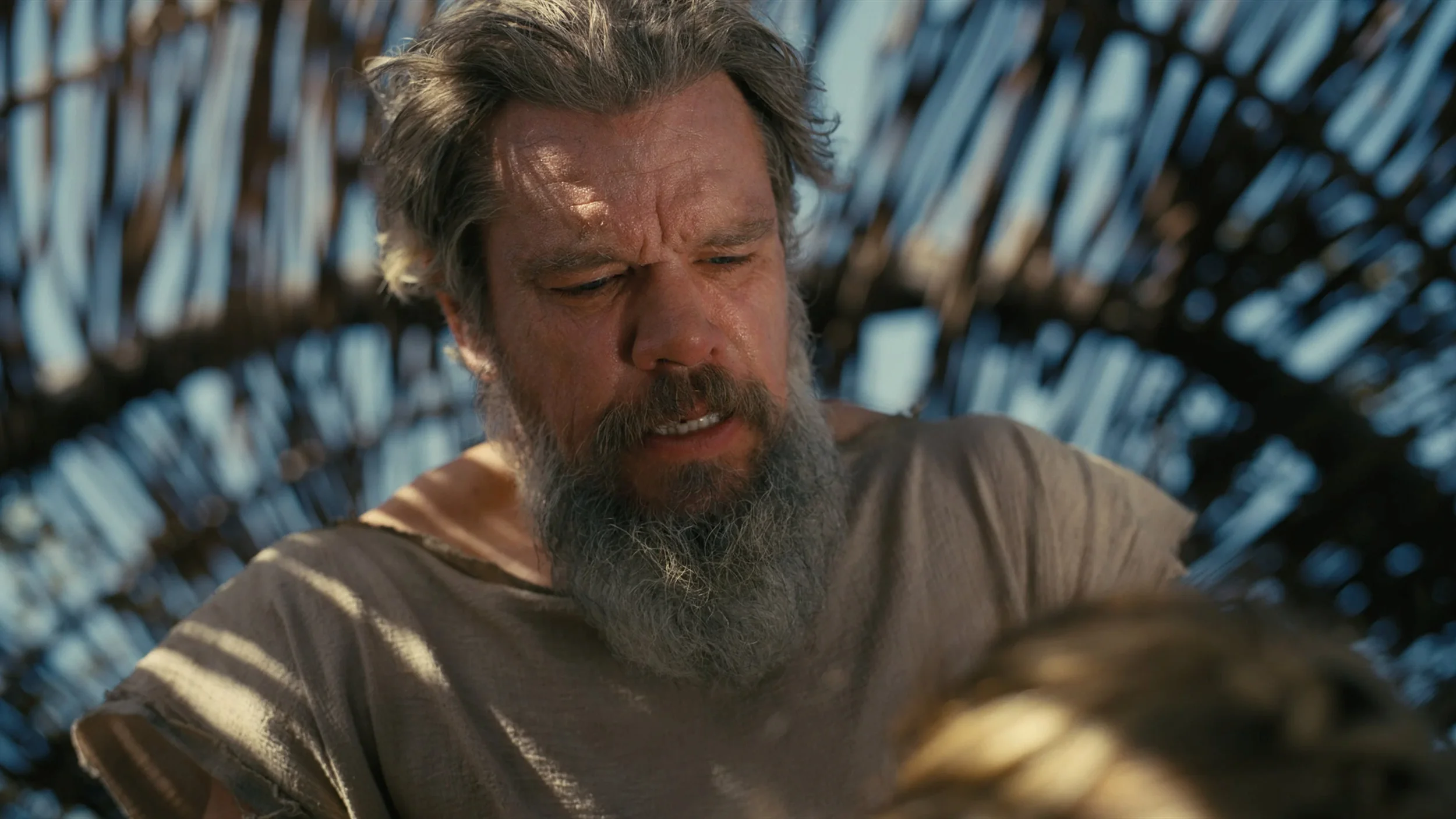
Overview
Odysseus, the legendary King of Ithaca, embarks on a long and perilous journey home following the Trojan War. Throughout his voyage, he is forced to confront the whims of gods, mythological monsters, and trials that stretch both his cunning and his humanity to the breaking point.
R | Action, Adventure, Fantasy | 2h 53m
Rating: ★★★★☆ 4/5
So how do you translate one of the foundational works of Western literature onto the biggest screen possible without losing what made Homer's Odyssey endure for nearly 3000 years? More importantly, how do you even begin to unpack a film this massive? (I will try and most likely fail at articulating myself)
The Odyssey is neither the untouchable “masterpiece” nor the “disaster” that people seem determined to call it. Like the voyage itself, the film is messy, unpredictable, grand, and epic. Nolan delivers exactly what he promises: a cinematic spectacle that demands to be seen on the biggest screen possible.
Nolan wisely opens not with Odysseus himself, but with a bard recounting his legend. Before we meet the man, we meet the myth. From there, we're introduced to Telemachus (Tom Holland), an impulsive young man desperately searching for a father he's only heard stories about, and Penelope (Anne Hathaway), Queen of Ithaca, who becomes the emotional backbone of the film. Hathaway is extraordinary. Her performance constantly shifts depending on who's occupying the room with her: vulnerable in solitude and calculating whenever she's forced to entertain the pursuit of the suitors. Speaking of suitors, Robert Pattinson gives Antinous a serpent-like quality, constantly changing his face depending on who he's manipulating. How does the man continue to shapeshift?
Nolan structures the film around two intersecting journeys: the political battle unfolding in Ithaca and Odysseus' impossible voyage home. While Penelope and Telemachus struggle to hold onto the kingdom with fading hope that Odysseus will ever return, the film cuts between them and the hero's increasingly desperate encounters across the sea. One of the film's strongest emotional threads is watching Telemachus evolve from a reckless boy chasing stories into a man capable of carrying his father's legacy.
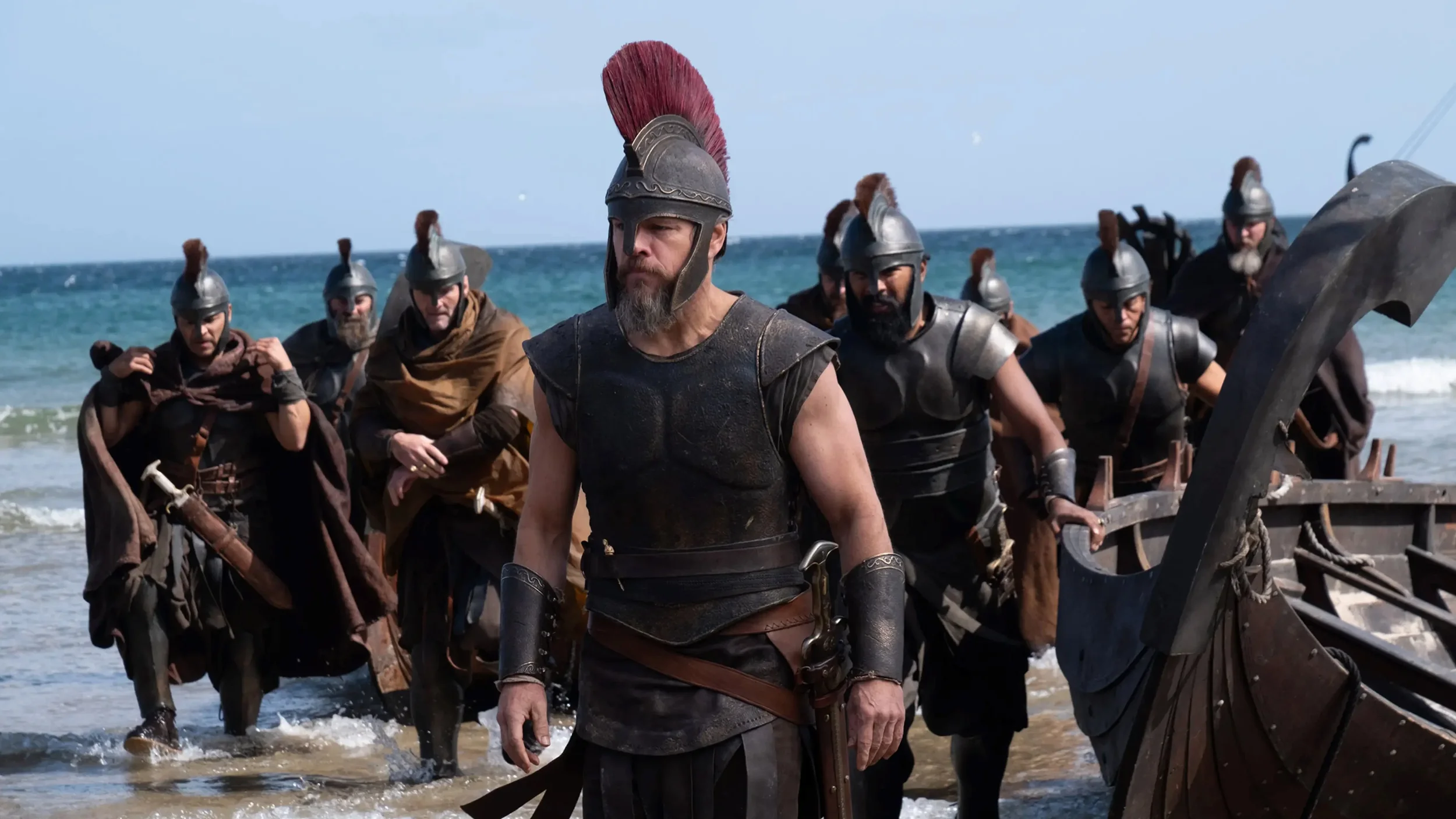
Odysseus' journey is propulsive, thanks in large part to Ludwig Göransson's thunderous score (be warned, this film is LOUD), but what impressed me even more was the sound design. Every crashing wave and every battle feels enormous. Alongside this, we are given flashes of Troy through fragmented memories, constantly reminding us that this is about surviving a war, not just winning one.
The film is always pushing us to ask whether Odysseus is a hero or simply another man broken by violence. His reckless choice to not show mercy to the Cyclops becomes another step in his unraveling. His crew slowly turns against him, and the man once celebrated for his intelligence becomes isolated by his own decisions. The decisions that make him believe his fate is still in his own hands but also that his actions do not have consequence of others. A leader who chooses himself, instead of looking at compassion for others.
That's ultimately what I found most compelling about Nolan's adaptation. The mythical creatures almost become manifestations of Odysseus' guilt, raising the question of whether these horrors are entirely real or simply how a traumatized man experiences the world. Matt Damon delivers a performance worthy of all praise with his internal battles and external transformation. Points where I could see the weathering of time just from his facial expressions alone.
The film also becomes a meditation on fate and free will. Are these men choosing their paths, or are they trapped by prophecy, by the gods, or by the consequences of their own actions? There is a beautiful haunting visions in Hades of soldiers literally covered in the ashes of war or the devastating sequence on Helios' island. It would be easy to dismiss many of the visual effects as another Nolan magic trick, reminding me of The Prestige, but nearly every effect serves a thematic purpose. The transformations, achieved through practical effects and incredible in-camera techniques, reveal the men for who they've truly become. Nolan repeatedly shows men surrendering to their worst impulses. Before the time Poseidon's wrath consumes them at we see the men stripped of their humanity. Driven only by violence and survival, marching toward Hades. Odysseus meanwhile, is confronting the moment he loses his illusion of control.
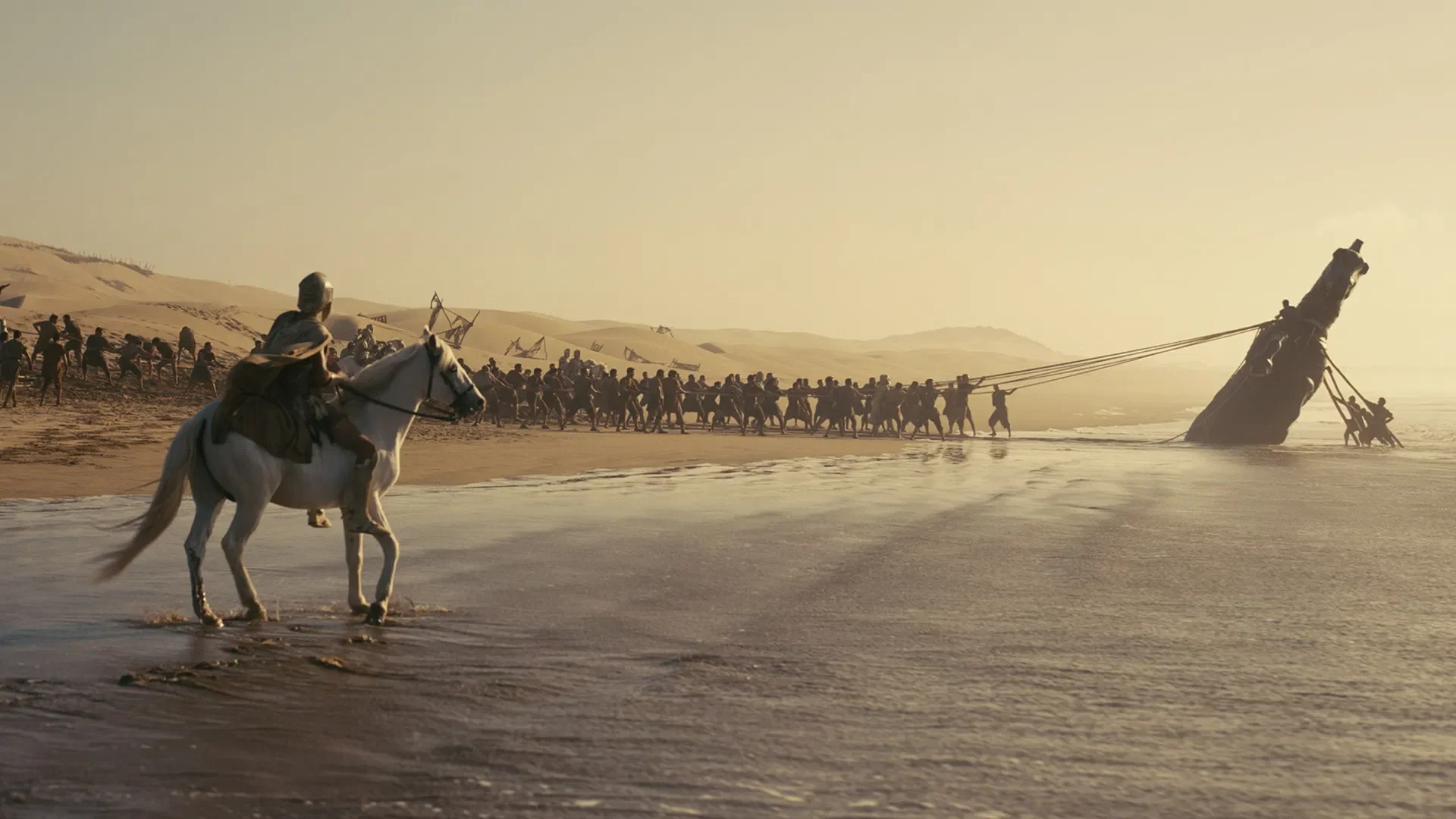
Christopher Nolan feels like he is arriving at the destination every one of his films has been pointing toward. There are echoes of his entire filmography woven throughout this adaptation. The small tokens and objects Odysseus clings to carry the same emotional weight as the totems in Inception. They are physical reminders of a reality he's terrified of losing. The practical effects and sleight-of-hand transformations remind me of The Prestige, where the "magic" and mythmaking are really excellent craftsmanship in service of emotional truth. There's also the longing to return home to family that immediately reminded me of Interstellar, but where Cooper races against time to return to the people he loves, Odysseus races toward becoming worthy of returning home at all.
Most importantly, this feels like the thematic continuation of Oppenheimer. That film wrestled with the morality of creating destruction, asking whether humanity could ever contend with what it had unleashed. The Odyssey feels like it gives us a closer answer. Troy is Nolan's nuclear bomb, and we explore what remains of the people who committed these heinous acts. Victory has already happened, and all that's left are men trying to survive the people they became because of it. It follows you across oceans, into your home, into your family, and ultimately into your own memory. Odysseus must reconcile the man who left for Troy with the one who somehow survived it.
That idea really cemented itself for me through Elliot Page's portrayal of Sinon. It's a relatively brief performance, but one that really stuck with me. Sinon becomes the first casualty of the journey home. Watching Page's performance, I couldn't help but feel that the film's emotional center exists in those fleeting moments where characters recognize that no amount of glory can erase what war has taken from them. There is a cost for the sacrifice, we see the test of what it means to become a man who chooses bravery.
Jumping to the third act, it pays off this journey beautifully. Odysseus returns home as a as weary beggar who has paid dearly for every victory. His greatest weapon has never been his strength or speed but his cunning and intelligence, and Nolan remembers that to give us a roaring end. The climactic battle against the suitors is exhilarating (my audience broke into applause multiple times) The part that makes it work is we finally see the return to Ithaca as a man who is no longer the same one who left.
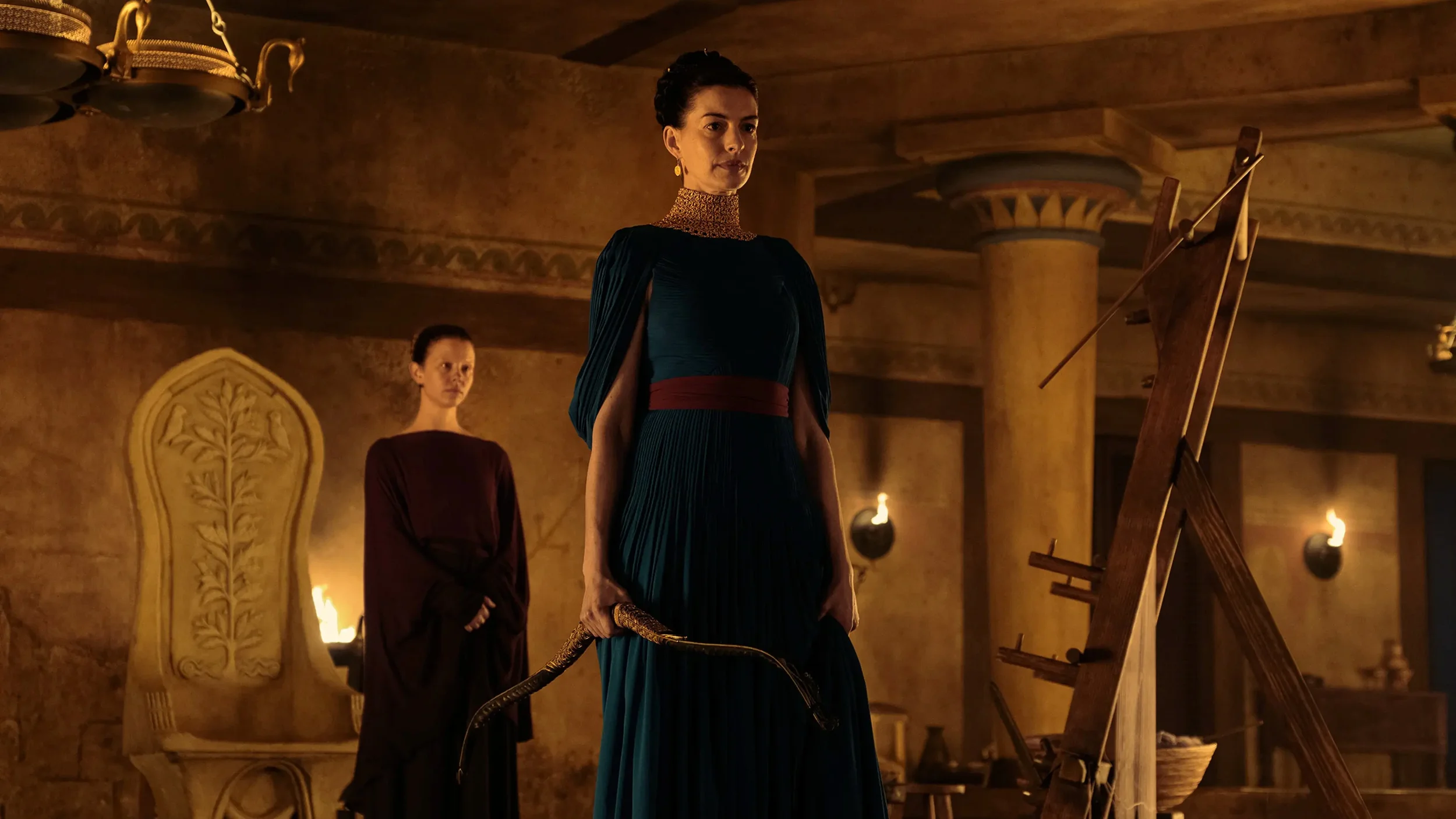
For all of Nolan's obsession with scale, this also contains some of the warmest emotional moments of his career. The IMAX photography is amazing. The texture of the images gives the myth an almost tactile feel. At the same time, I do think the new IMAX camera system occasionally works against the performances. Some conversations feel oddly disconnected, almost as if actors are delivering lines toward the mirror system rather than each other. The rhythm occasionally feels disjointed in favor of capturing the image.
Even then, the cast consistently overcomes those hurdles. Matt Damon gives Odysseus a weariness that grows heavier with every encounter. Anne Hathaway is phenomenal throughout, while John Leguizamo brings remarkable warmth to Eumaeus. Nolan's casting is remarkably intuitive because everyone embodies an archetype without reducing the characters to one. Tom Holland charts Telemachus' coming-of-age journey. Robert Pattinson makes Antinous endlessly manipulative. Lupita Nyong'o lends Helen an almost mythical presence and beauty. Jon Bernthal is wonderfully boisterous as Menelaus, Himesh Patel gives Eurylochus enough internal conflict to never feel like a simple follower, and Zendaya's Athena is both a distant goddess and a comforting, haunting presence guiding Odysseus on his journey home.
I think what impressed me most is that Nolan wrestles with why this story has survived for centuries. He deconstructs masculinity, showing how pride and violence leave men hollow. Just as importantly, this may be the first film in his career where the women aren't merely orbiting the protagonist. Penelope in particular, but the other women Odysseus encounters throughout his journey become the film's moral center. They possess the wisdom the warriors continually ignore. Without them, there is no journey home.
On a technical level, The Odyssey is one of the great epics. Emotionally, it doesn't always reach the same heights of ambition but when it does, it reminds you why this story has survived for nearly three thousand years and why Nolan's adaptation feels so relevant today. Like Homer's poem, Nolan's film asks whether a man can truly find his way home after war has turned him into the very monster he once fought.
